The payroll platform for the companies that run payroll for everyone else — and the ones that run their own.
Payroll, benefits, workers’ comp and compliance in one system, built to stop errors before they happen. It runs on infrastructure you own, where your workforce data stays — whether you run payroll for your own company or for hundreds of others.
Who it’s for
One platform, four ways it gets used
Whether you run payroll for a book of clients, run your own company’s payroll in-house, place a prospect with a PEO, or pay a contingent workforce, Stratum meets you where your work starts.
For payroll companies
PEOs & domestic EORs · ASOs & payroll bureaus · CPA payroll practices
Run every client’s payroll, benefits, workers’ comp and compliance from one system, with each client separated and a portal for their own HR admin.
- 50-state payroll tax engine
- Benefits, COBRA and carrier files
- Service desk and sales pipeline built in
For employers
A single business running payroll in-house · No operator in the middle
The same platform a PEO licenses to serve hundreds of companies, deployed for one: yours. Your own EIN, your own carriers, your own servers.
- Standalone 941 and 940 under your own EIN
- Benefits, leave and workers’ comp included
- One deployment that holds only your data
For brokers
Benefits and insurance brokers · General agencies
Drop in a prospect’s census, payroll register and declarations page. Get one graded customer file and one link that gets the employer to fix the rest.
- Row-by-row census grading
- Cross-document checks
- Automatic reminders and escalation
For staffing agencies
Temporary · Contract · Temp-to-perm
Pay workers by assignment and bill clients by contract, with bill rate and pay rate applied to every hour type so your margin is right on every invoice.
- Assignments and client rate cards
- Margin, AR aging and credit holds
- No-login timesheet approval for clients
Staying on PrismHR or isolved?Add Stratum’s compliance, termination, case management or prospecting tools without switching payroll.
See the product
One system for your team. A portal for every client.
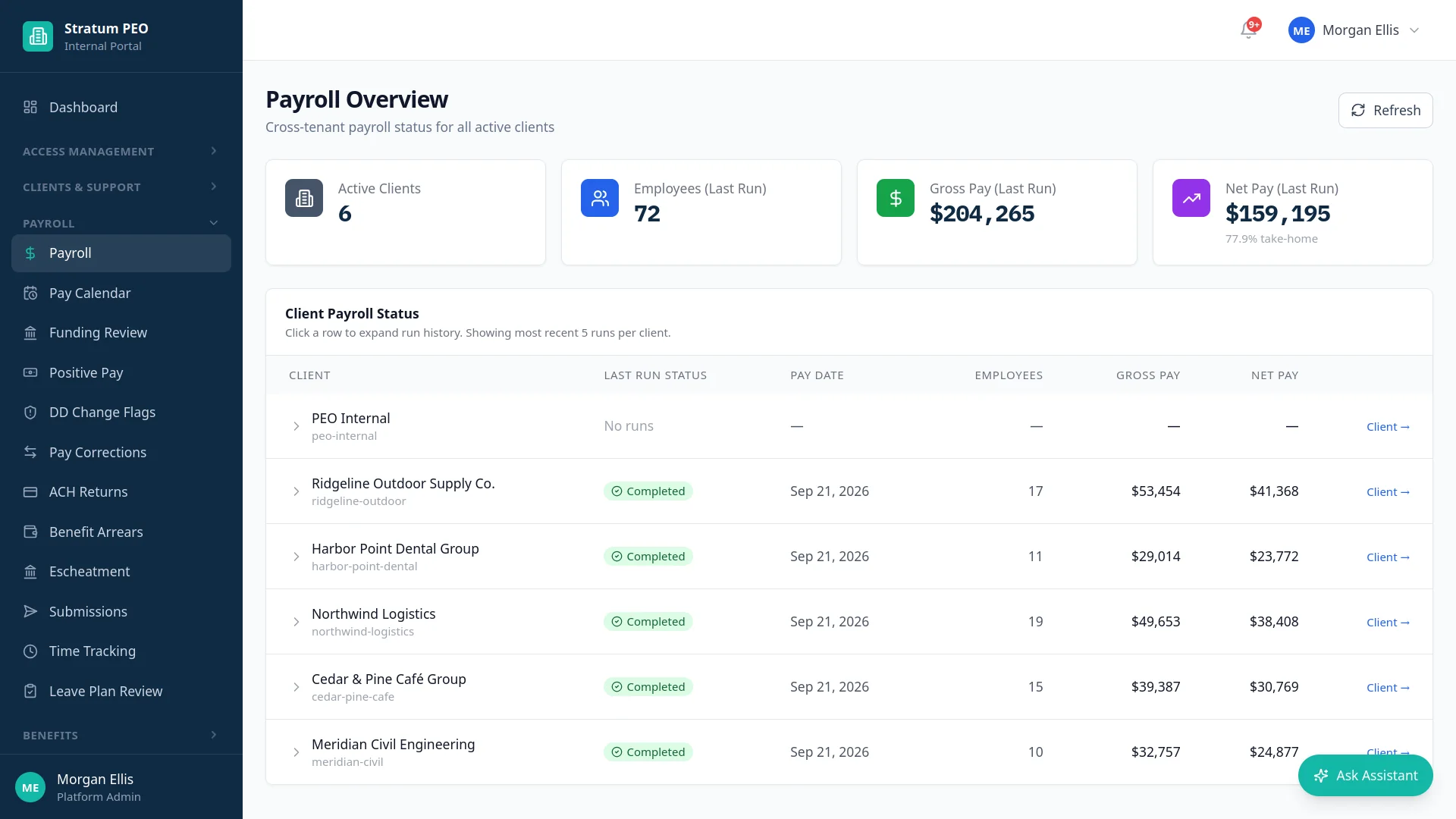
Your operations staff work every client from one place, and each client’s own HR admin and employees get a portal of their own.
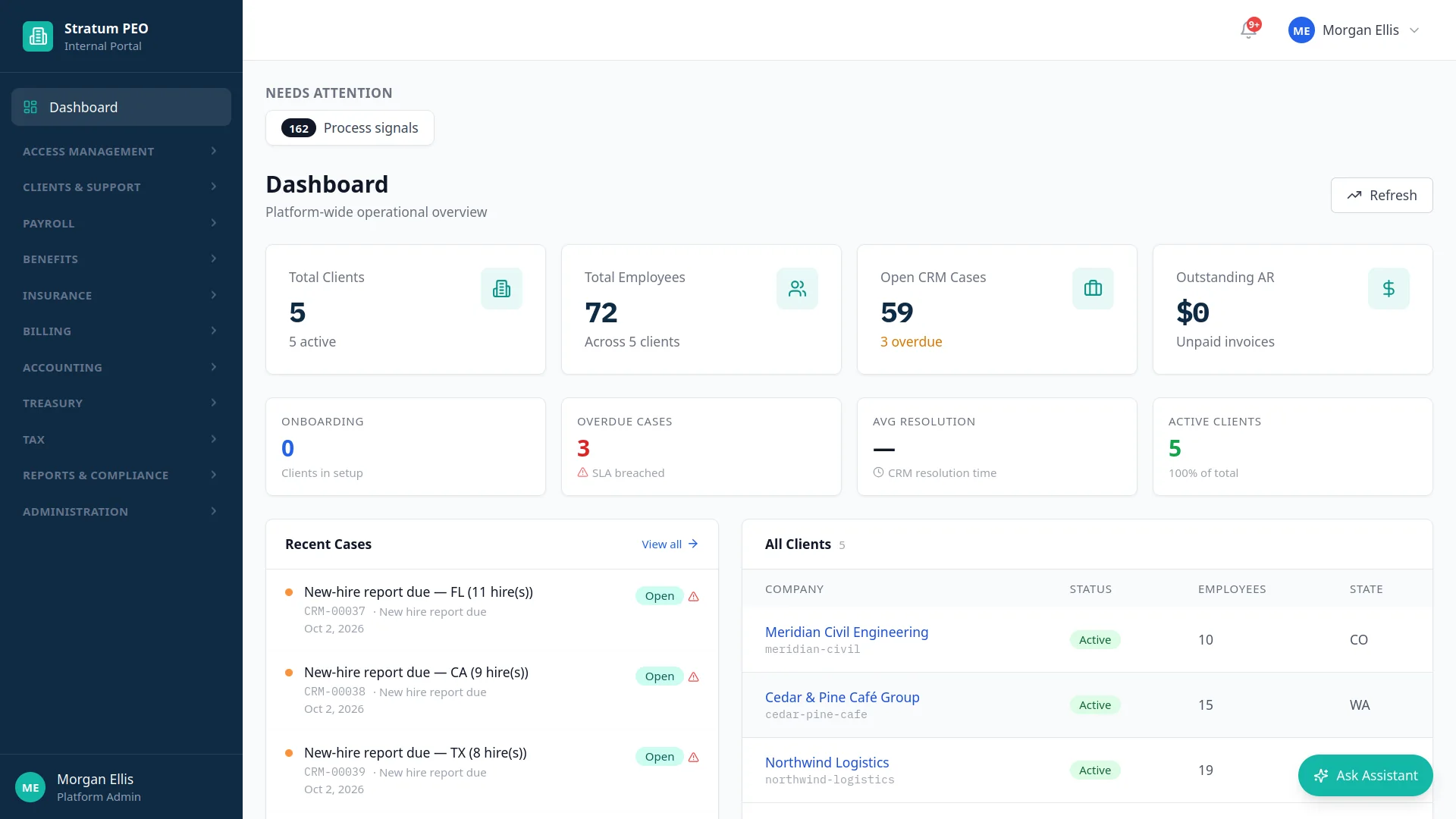
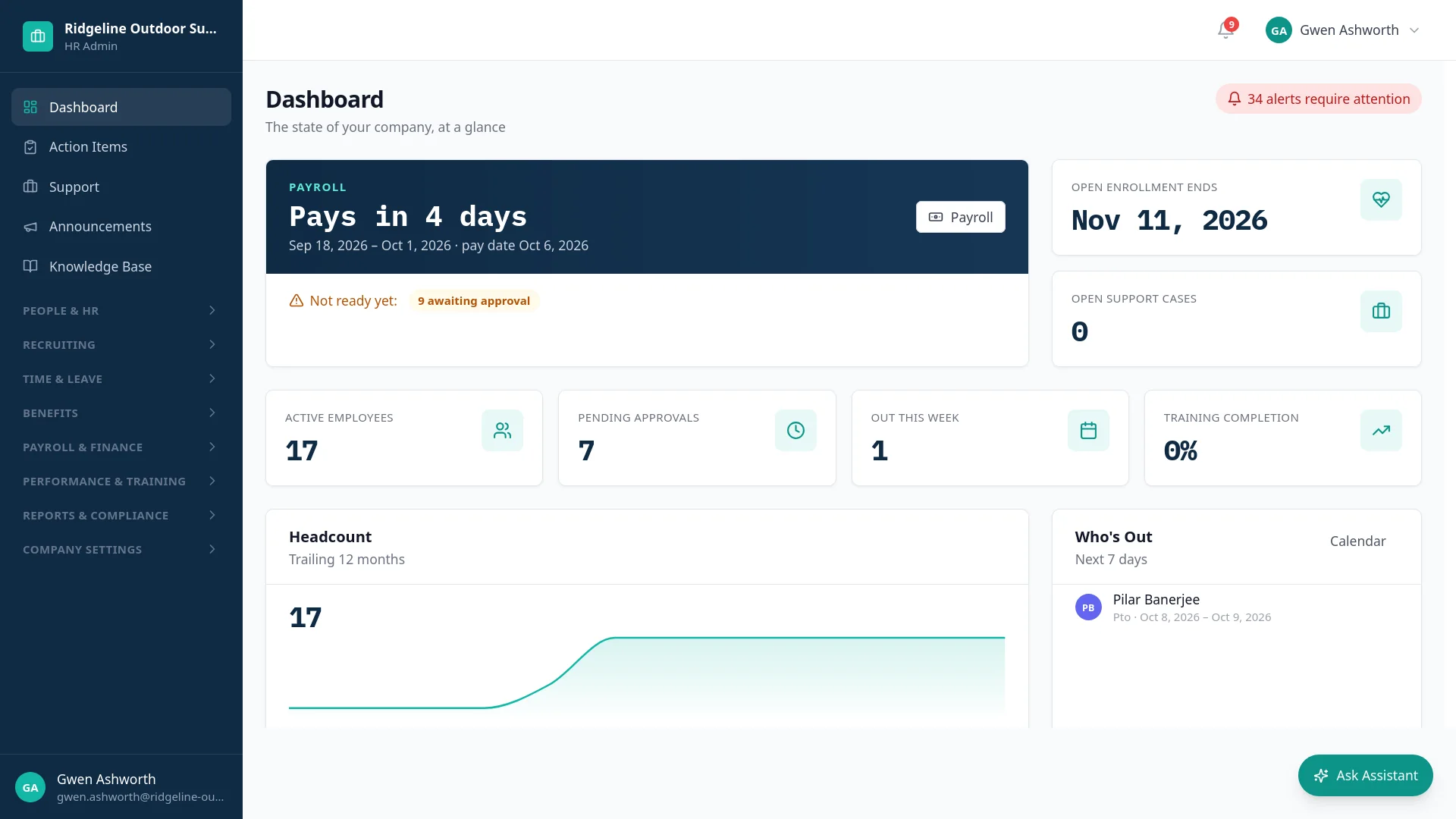
Shown with demo data. Companies and people are fictional.
Data sovereignty
It runs on your infrastructure, so your data stays there
Stratum is licensed to you and deployed into your own environment, not rented from us. That one decision is what puts your payroll data inside your own perimeter, under your own controls, and open to review by your own security team instead of a vendor’s attestation.
See the security detailYour infrastructure, your database
Stratum is licensed and deployed into your own servers or cloud account. There is no copy of your database on our side, and no standing access to it.
The jurisdiction you choose
Because the deployment is yours, so is its location. Payroll and employee records stay in the region or country your own policy requires, not wherever a vendor happens to run.
Data leaves only where you send it
Your bank, your benefit carriers, your tax-filing provider, E-Verify, and your mail, email and text services. Each one is a connection you set up, and AI features stay off until you add your own provider key.
Nothing has to phone home
Your license is a signed token your install verifies by itself, with no call to us. Payroll keeps running whether or not Stratum is reachable, which is a different kind of continuity than an escrow clause.
What Stratum receives, stated plainly: nothing, unless you choose otherwise. A once-a-day license check-in (an anonymous install fingerprint, the number of companies set up and the license status, never client or employee data) is sent only if your agreement names an address for it. Error reports reach us only if you turn them on, with emails, Social Security numbers and account numbers stripped out first.
Lean Six Sigma, by design
Most systems help you fix errors. Stratum removes where they start.
In most payroll operations, quality comes from people catching mistakes after the fact. Stratum was designed by a Lean Six Sigma Black Belt who spent eight years improving PEO operations, and it applies the same two principles to the software itself: take out the steps that add no value, and make the common errors impossible to make.

Dillon Flack, Founder & CEO
Ex-Microsoft · Lean Six Sigma Black Belt
Waste removed
Entered once, used everywhere
A benefit election drives the payroll deduction and the carrier enrollment file directly. Nobody re-keys it.
Reconciliation the system does for you
Carrier invoices are matched against elections and each payroll against the last one, with only the differences sent to a person.
Paperwork that fills itself in
Final pay, COBRA deadlines and separation notices are prepared from live data instead of assembled by hand.
Defects prevented
Checked at entry, not at audit
A leave plan is tested against state minimums the moment it is saved, before any employee is affected.
The rules are built in
California meal-break premiums, daily overtime and bonus-adjusted overtime rates are calculated, not remembered.
Verified to the cent
Every state’s withholding is tested to the cent against published tables before it ships.
Proof
Claims you can check
A standing test program backs the product claims on this site, and the parallel pilot lets you check them on your own payroll.
Tested to the cent
Every state’s withholding is pinned by exact-value tests against published tables. A tax update that changes a result can’t ship unnoticed.
Checked against real wage data
The tax engine’s coverage has been checked against hundreds of thousands of public wage records from employers across every state.
Client separation, tested continuously
Automated tests confirm that one client can never see another client’s data.
Recovery rehearsed
A full restore from backup is rehearsed against a populated database, with a measured recovery time.
Now taking founding partners
We onboard a small number of operators at a time, with founding-partner pricing for the first few. Every implementation is led by the people who built the platform.